Accessibility is an important part of creating a welcoming, safe, and easy-to-navigate business environment. From identifying accessible washrooms to helping visitors find elevators, exits, offices, and entrances, accessible signage makes it easier for everyone to move confidently through a building.
You may have heard the term ADA signage, particularly when researching accessible signs online. However, businesses in Mississauga and elsewhere in Ontario should also understand AODA signage requirements and applicable requirements under the Ontario Building Code.
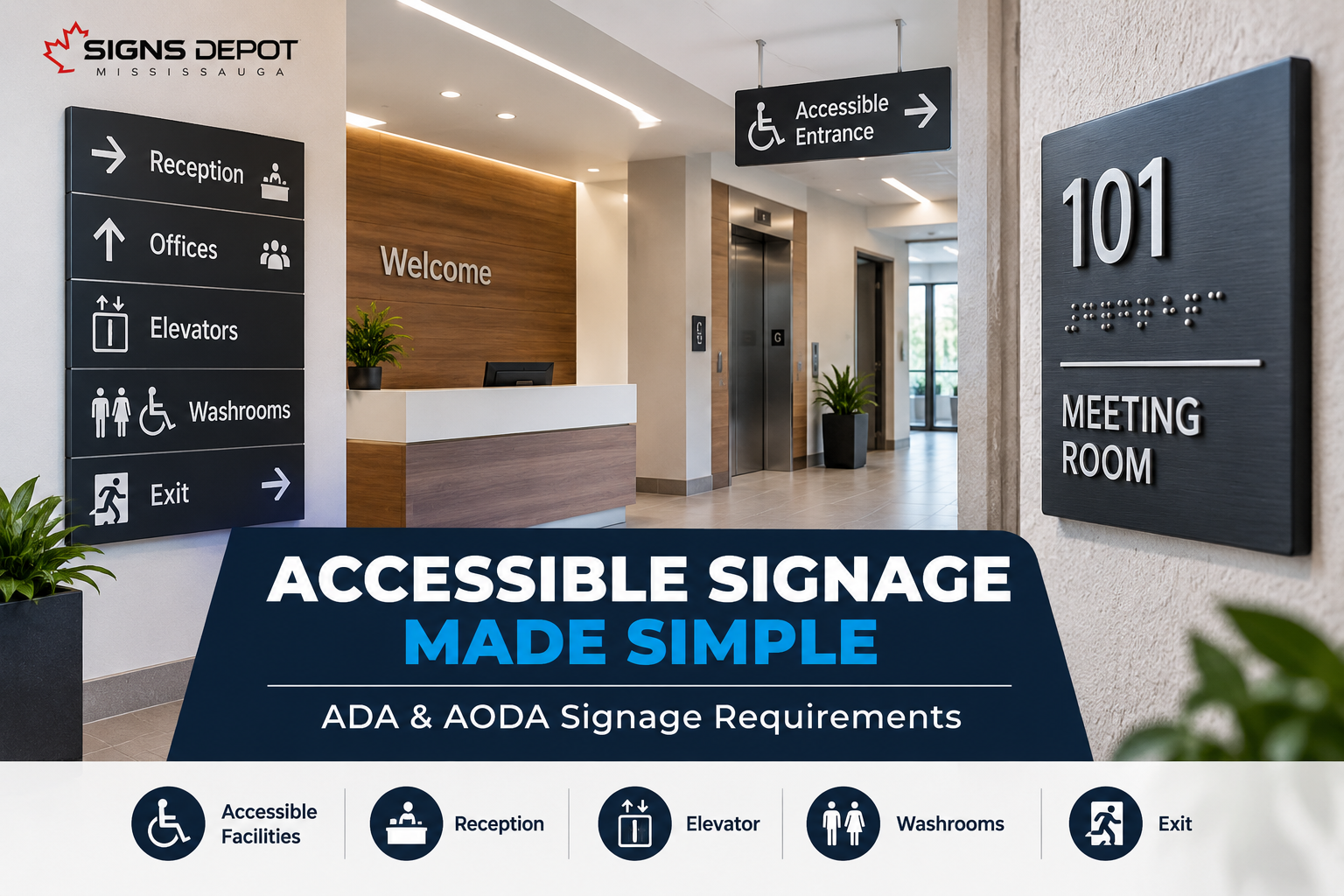
Accessible signs may incorporate features such as Braille, tactile lettering, high-contrast colours, accessible pictograms, and clear visual information. The right combination depends on the purpose and location of the sign.
Whether you operate an office, retail store, medical clinic, restaurant, commercial facility, or another public-facing space, understanding accessible signage can help you create a more inclusive environment.
What Is ADA Signage?
The Americans with Disabilities Act (ADA) is a U.S. law, and the term “ADA signs” is commonly used online to describe signage designed to help make spaces accessible to people with disabilities.
For businesses in Mississauga and Ontario, however, accessibility requirements are primarily governed by Canadian, provincial, and applicable municipal requirements, including the Accessibility for Ontarians with Disabilities Act (AODA) and the Ontario Building Code.
That distinction is important.
If you are researching ADA compliant signs in Mississauga, what you may actually need are signs designed to meet applicable Ontario accessibility requirements.
Accessible signage can include:
- Braille signs
- Tactile signs
- Accessible washroom signs
- Room identification signs
- Accessible entrance signs
- Elevator signs
- Exit identification signs
- Directional and wayfinding signs
- Accessible parking signs
- International Symbol of Access signs
Businesses looking for signage that combines accessibility with professional design can explore our Custom Signs solutions in Mississauga.
Why Is Accessible Signage Important?
Good signage does much more than identify a room.
For someone unfamiliar with a building, signs provide essential information about where they are, where they need to go, and how to get there.
Accessible signage can be especially important for people with visual, mobility, hearing, or other disabilities.
Well-planned signs can help:
Improve accessibility
Tactile lettering, Braille, pictograms, and strong visual contrast can make information accessible to a wider range of visitors.
Make navigation easier
Clear signs help visitors locate entrances, exits, elevators, washrooms, departments, offices, and other important areas.
Create consistency
Keeping sign styles and placement consistent makes a building easier to understand and navigate.
Improve customer experience
Visitors should not have to repeatedly ask employees where basic facilities are located.
Support compliance
Certain buildings, spaces, and signs may be subject to accessibility requirements under applicable building codes, standards, and regulations.
ADA vs AODA Signage: What’s the Difference?
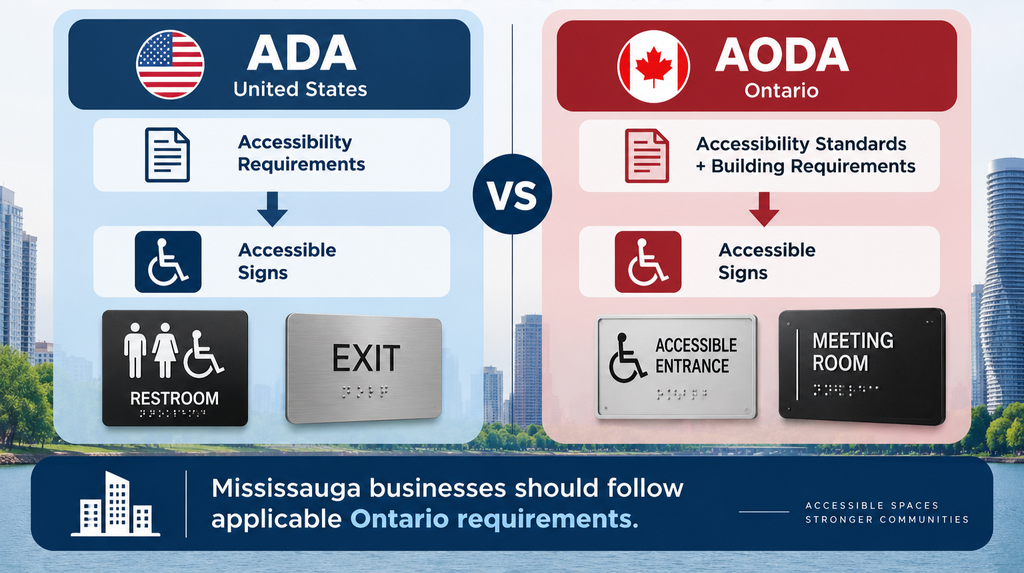
The terms are related to accessibility, but ADA and AODA are not interchangeable.
| ADA Signage | AODA / Ontario Accessibility |
| Associated with the United States | Applies within Ontario |
| ADA = Americans with Disabilities Act | AODA = Accessibility for Ontarians with Disabilities Act |
| Commonly referenced in online accessibility-sign searches | Relevant to Ontario organizations and businesses |
| Includes accessibility requirements for signs and spaces | Works alongside Ontario accessibility standards and Building Code requirements |
For a Mississauga business, simply ordering a sign advertised online as “ADA compliant” does not automatically mean it satisfies every requirement applicable to your Ontario property.
Sign requirements should be determined according to the location, building type, sign purpose, and applicable Ontario regulations and codes.
Key Accessibility Features to Consider for Signs
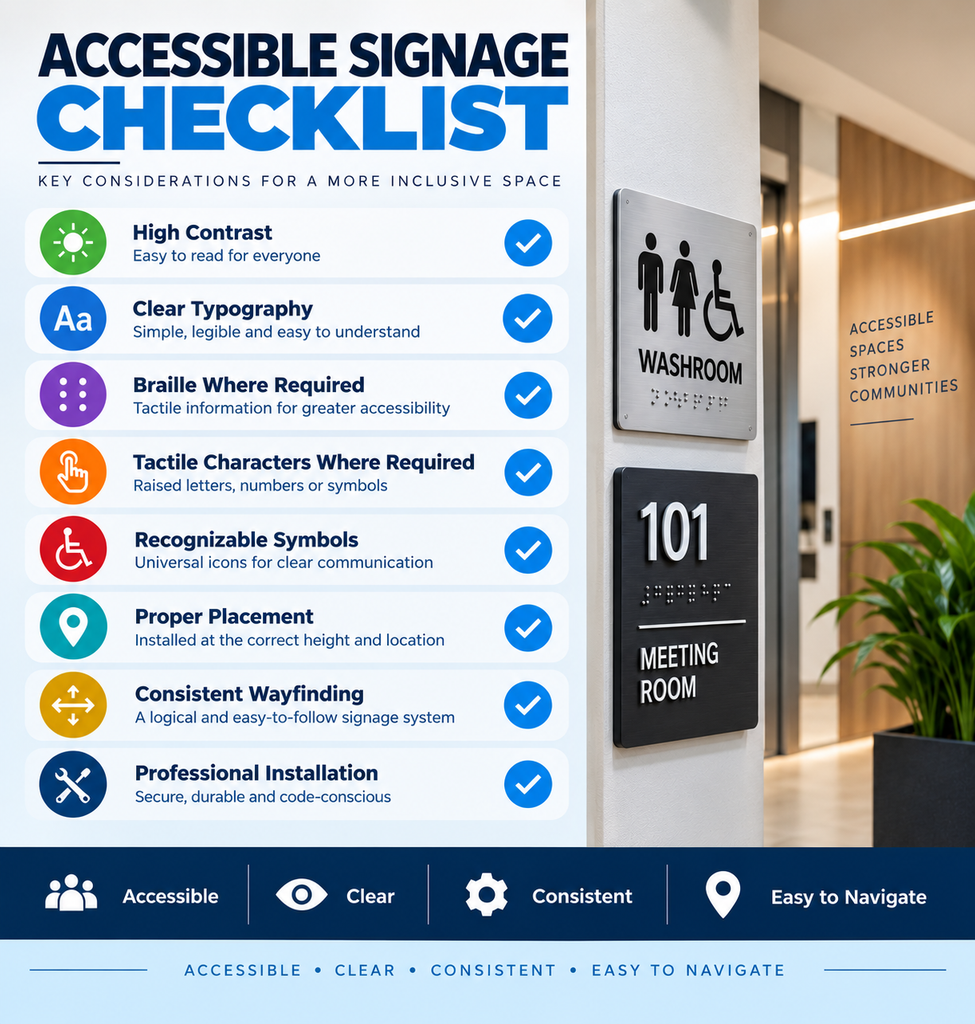
Accessible signage is not simply a regular sign with a wheelchair symbol added to it. Depending on the sign and its application, several design characteristics may need to be considered.
1. Braille
Braille allows information to be read through touch.
It can be incorporated into identification and other tactile signs where required, allowing people who are blind or have low vision to identify important rooms, facilities, or destinations.
Braille needs to be properly produced and positioned rather than added simply as a decorative feature.
2. Raised or Tactile Characters
Some accessibility signs provide raised letters, numbers, or symbols that visitors can identify by touch.
Tactile information can be particularly useful for:
- Room numbers
- Washrooms
- Permanent rooms
- Building exits
- Floor identification
- Regulatory information
- Warning information
The Ontario Building Code includes requirements for visual and tactile information on certain signs required by the Code.
3. High Colour Contrast
A beautiful sign is not useful if visitors cannot read it.
The characters and symbols should be clearly distinguishable from their background. Strong contrast can make signs easier to read for people with low vision and can also improve general readability.
For example:
Better: Dark lettering + light background
Better: Light lettering + dark background
Avoid: Similar-coloured lettering and background
Highly reflective finishes and excessive glare should also be considered carefully because they can reduce readability.
4. Easy-to-Read Typography
Decorative typography may work well for certain branding applications, but accessibility and directional signs should prioritize clarity.
Simple, legible lettering helps visitors recognize information quickly.
Fonts should avoid unnecessary decorative details, while characters should be sized appropriately for their intended viewing distance.
5. Accessible Symbols and Pictograms
Recognizable pictograms can communicate information quickly without requiring visitors to read large amounts of text.
Common examples include symbols for:
♿ Accessible facilities
🚻 Washrooms
🛗 Elevators
🅿 Accessible parking
➡ Directional information
🚪 Entrances and exits
Where required, the International Symbol of Access can identify accessible routes, facilities, entrances, parking areas, and other accessible features.
Where Are Accessible Signs Commonly Needed?
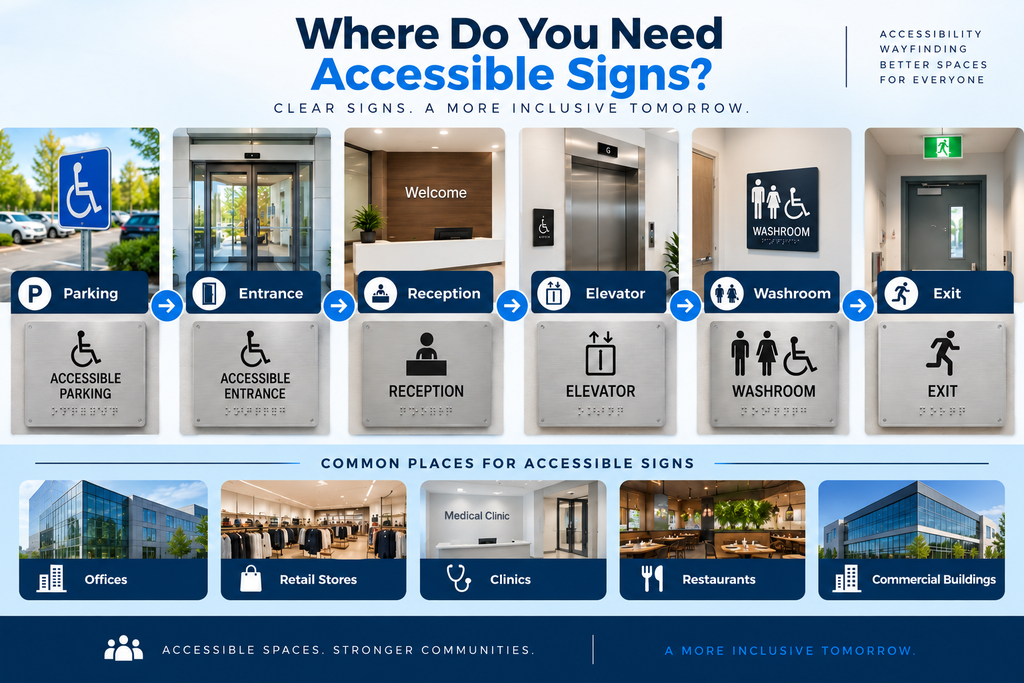
The exact signage requirements will depend on the property, but accessible signs are commonly used throughout commercial and public environments.
They may be found at:
Entrances → Reception → Elevators → Offices → Washrooms → Exits
Other common locations include:
- Accessible parking areas
- Building directories
- Meeting rooms
- Medical rooms
- Stairwells
- Emergency exits
- Floor identification areas
- Accessible entrances
- Public facilities
- Service areas
This is why accessibility should be considered as part of an overall signage and navigation plan rather than treating every sign separately.
Businesses with larger facilities can combine accessible identification signs with professional Wayfinding Signs to create a more intuitive visitor journey.
Accessible Washroom Signs
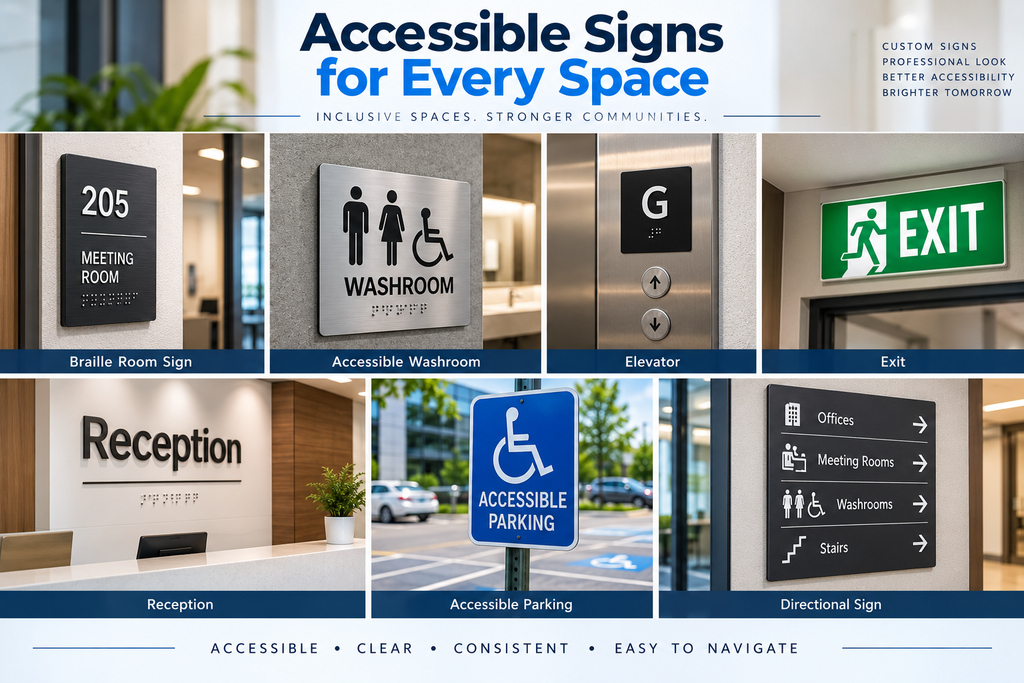
Washrooms are one of the most recognizable applications for accessibility signage.
Depending on the facility and applicable requirements, washroom identification signage may incorporate:
- Clear pictograms
- Accessible facility symbols
- High-contrast colours
- Raised characters
- Braille
- Appropriate mounting and positioning
The objective is straightforward: visitors should be able to identify the facility independently and confidently.
Don’t Forget About Sign Placement
Designing an accessible sign correctly is only part of the process.
Where the sign is installed matters too.
For tactile signage in particular, placement needs to allow someone to locate and read the sign safely. Ontario Building Code provisions include specifications regarding the positioning of certain tactile signs near doors.
Poor placement can make even a well-designed sign difficult to use.
Businesses should therefore consider signage design and installation together rather than treating them as two unrelated steps.
Accessible Directional and Wayfinding Signs
Imagine entering a large medical clinic for the first time.
You need to find:
Reception → Department → Washroom → Exit
Without clear directional signage, the experience quickly becomes frustrating.
Accessible Wayfinding Signs can make complex environments easier to navigate by using logical routes, readable typography, consistent placement, recognizable symbols, and clear directional information.
Effective wayfinding is particularly useful in:
- Medical clinics
- Office buildings
- Shopping centres
- Schools
- Hotels
- Government facilities
- Warehouses
- Multi-tenant commercial buildings
Accessibility Doesn’t Mean Giving Up Your Branding
Accessible signage can still look professional and complement your brand.
Colours, materials, shapes, finishes, and overall sign systems can often be designed to coordinate with a building’s interior and corporate identity while maintaining the accessibility features required for the application.
For example, a modern office may use elegant acrylic room signs with tactile lettering and Braille, while a healthcare facility may prioritize simple high-contrast signs and highly recognizable pictograms.
For businesses planning a coordinated sign system, Custom Signs can help maintain a consistent appearance throughout the property.
Common Accessibility Signage Mistakes
Even small design decisions can reduce a sign’s usability.
Some common mistakes include:
- Using very small lettering
- Poor contrast between text and background
- Excessively decorative fonts
- Installing signs in inconsistent locations
- Using reflective surfaces that create glare
- Missing tactile information where it is required
- Incorrect Braille production
- Placing tactile signs where they are difficult to reach
- Using unclear symbols or directional arrows
- Treating accessibility signage as an afterthought
Planning the entire sign system before fabrication can help create a more consistent and accessible environment.
Which Businesses Should Consider Accessible Signage?
Accessible signage can be relevant to many types of facilities, including:
| Business / Facility | Common Signage Needs |
| Medical Clinic | Rooms, washrooms, reception, exits |
| Corporate Office | Room numbers, directories, washrooms |
| Retail Store | Entrances, washrooms, directional signs |
| Restaurant | Washrooms, accessible entrances, exits |
| Shopping Plaza | Parking, directories, entrances |
| Hotel | Room numbers, elevators, amenities |
| Commercial Building | Directories, offices, floors, exits |
Businesses upgrading their entire property may also want to coordinate accessible signs with their Building Signs and Storefront Signs to maintain consistent branding from the exterior to the interior.
Choosing Accessible Signs in Mississauga
Every building is different. The appropriate signage solution depends on the type of facility, sign location, intended information, building configuration, and applicable accessibility requirements.
Before ordering signs, consider:
- What information does the visitor need?
- Who needs to use the sign?
- From what distance will it be viewed?
- Does the sign need tactile information or Braille?
- Is an accessibility pictogram required?
- Where should the sign be installed?
- Does the design provide sufficient contrast and readability?
- Are there applicable Building Code, accessibility, or municipal requirements?
Taking these factors into account early can prevent inconsistencies and help create a more effective sign system.
Create a More Accessible Business with Signs Depot Mississauga
Accessible signage is about more than meeting requirements. It helps create a space where customers, employees, and visitors can find information and navigate more independently.
Signs Depot Mississauga provides custom signage solutions for businesses and commercial properties, including accessible signs, room identification signs, directional signs, wayfinding signs, and other custom signage.
Whether you are planning signs for a new facility, renovating an existing commercial space, or updating an outdated sign system, our team can help you develop signage that is clear, professional, and suited to your property.
Ready to improve accessibility throughout your property? Contact Signs Depot Mississauga to discuss custom accessible signage for your business.
Frequently Asked Questions About ADA & AODA Signs
- What is an ADA sign?
ADA signage generally refers to signage designed according to accessibility requirements associated with the U.S. Americans with Disabilities Act. In Ontario, businesses should instead determine which AODA, Ontario Building Code, and other applicable accessibility requirements apply to their property.
2. Are ADA and AODA signs the same?
No. ADA refers to U.S. accessibility legislation, while AODA is Ontario legislation. Although accessible signs may share design principles such as clear typography, contrast, tactile information, Braille, and recognizable symbols, businesses should follow the requirements applicable to their jurisdiction.
3. Do accessible signs need Braille?
Not every sign necessarily requires Braille. The requirement depends on the type and purpose of the sign and the applicable code or standard. Certain identification, regulatory, warning, and other tactile information signs may require Braille.
4. What are tactile signs?
Tactile signs contain information that can be interpreted through touch, typically using raised letters, numbers, symbols, and/or Braille.
5. Where are accessible signs commonly installed?
Accessible signs are commonly used around washrooms, exits, elevators, accessible entrances, parking areas, permanent rooms, floor identification areas, and other important destinations.
6. Can accessible signs match my business branding?
Yes. Accessible signage can be designed to coordinate with a company’s visual identity while incorporating the accessibility characteristics applicable to the particular sign.
7. Where can I order accessible signs in Mississauga?
Signs Depot Mississauga provides custom signage solutions for businesses and commercial properties in Mississauga. Signs can be designed according to the property’s functional, accessibility, wayfinding, and branding needs.